
UX RESEARCH · MIXED-METHODS RESEARCH
UX RESEARCH · MIXED-METHODS RESEARCH
AI & Future of Product Careers
AI & Future of Product Careers
How AI Is Changing the Boundary Between Designers and Engineers
How AI Is Changing the Boundary Between Designers and Engineers
How AI Is Changing the Boundary Between Designers and Engineers
A mixed-methods research study exploring how generative AI is changing workflows, professional identity, and career preparation for future designers and engineers.
A mixed-methods research study exploring how generative AI is changing workflows, professional identity, and career preparation for future designers and engineers.
View Full Research ↗
TIMELINE & STATUS
TIMELINE & STATUS
1 semester · Team of 1
1 semester · Team of 1
ROLE
ROLE
UX Researcher
UX Researcher
SKILLS
SKILLS
UX Research · Research Planning · Interview Design · Survey Design · Qualitative & Quantitative Analysis · Thematic Coding · Affinity Mapping · Insight Synthesis · Data Visualization · Research Presentation
UX Research · Research Planning · Interview Design · Survey Design · Qualitative & Quantitative Analysis · Thematic Coding · Affinity Mapping · Insight Synthesis · Data Visualization · Research Presentation
INSTRUCTOR REFLECTION
INSTRUCTOR REFLECTION
“Excellent. These insights are so important and timely. This research changed how I think about AI in education. I used to treat AI as a tool with clear boundaries, but this project showed me that AI is reshaping entire workflows rather than simply assisting individual tasks. It has inspired me to rethink how AI should be incorporated into my future syllabus.”
“Excellent. These insights are so important and timely. This research changed how I think about AI in education. I used to treat AI as a tool with clear boundaries, but this project showed me that AI is reshaping entire workflows rather than simply assisting individual tasks. It has inspired me to rethink how AI should be incorporated into my future syllabus.”
— NYU Professor Qingyan Ma
— NYU Professor Qingyan Ma
Why This Matters?
Why This Matters?
Why This Matters?
Companies no longer hire designers and engineers based solely on their discipline. AI is reshaping expectations for junior talent.
Companies no longer hire designers and engineers based solely on their discipline. AI is reshaping expectations for junior talent.
My Research Process
My Research Process
My Research Process
01
01
Define the Research Scope
Define the Research Scope
Define the Research Scope
Defined the research question, target participants, and research direction
Defined the research question, target participants, and research direction
02
02
Reviewed Existing Research
Reviewed Existing Research
Reviewed Existing Research
Reviewed existing literature to identify gaps and refine the research focus
Reviewed existing literature to identify gaps and refine the research focus
03
03
Designed the Study
Designed the Study
Designed the Study
Created interview guides, surveys, and participant recruitment plans
Created interview guides, surveys, and participant recruitment plans
04
04
Collected Data
Collected Data
Collected Data
Conducted stakeholder interviews and gathered survey responses from students
Conducted stakeholder interviews and gathered survey responses from students
05
05
Analyzed the Data
Analyzed the Data
Analyzed the Data
Coded interview data, compared survey patterns, and identified key themes
Coded interview data, compared survey patterns, and identified key themes
06
06
Synthesized Insights
Synthesized Insights
Synthesized Insights
Combined qualitative and quantitative findings into actionable research insights
Combined qualitative and quantitative findings into actionable research insights
Research Design
Research Design
Research Design

Qualitative Research — Interviews
Qualitative Research — Interviews
Qualitative Research — Interviews
Semi-structured interviews helped me understand how students use AI in their projects, how they define their roles, and how AI affects their career preparation.
Semi-structured interviews helped me understand how students use AI in their projects, how they define their roles, and how AI affects their career preparation.

Quantitative Research — Surveys
Quantitative Research — Surveys
Quantitative Research — Surveys
The survey validated interview findings and revealed broader patterns in AI adoption and career preparation.
The survey validated interview findings and revealed broader patterns in AI adoption and career preparation.
Research Execution
Research Execution
Research Execution

Interview
Interview
Interview
Create a relaxed conversation where participants feel comfortable sharing their experiences. Share your own thoughts when appropriate instead of only listening.
Create a relaxed conversation where participants feel comfortable sharing their experiences. Share your own thoughts when appropriate instead of only listening.
Survey
Survey
Survey
Emphasize that the survey can be completed in under 5 minutes. Explain how the insights from the survey may benefit participants.
Emphasize that the survey can be completed in under 5 minutes. Explain how the insights from the survey may benefit participants.
Qualitative Data Analysis
Qualitative Data Analysis
Qualitative Data Analysis

Step 1: Organizing Raw Interview Data
Step 1: Organizing Raw Interview Data
Step 1: Organizing Raw Interview Data
• Collected handwritten notes and cleaned transcripts from participant interviews.
• Collected handwritten notes and cleaned transcripts from participant interviews.
• Reviewed the transcripts to find meaningful statements related to AI use, role identity, and career preparation.
• Reviewed the transcripts to find meaningful statements related to AI use, role identity, and career preparation.
• The goal was to move from messy raw data into text that could be coded.
• The goal was to move from messy raw data into text that could be coded.
Step 2: From Quotation to Initial Code
Step 2: From Quotation to Initial Code
Step 2: From Quotation to Initial Code
• Organized codes into a more readable way.
• Organized codes into a more readable way.
• Created a definition for each code to explain the meaning behind the codes.
• Created a definition for each code to explain the meaning behind the codes.


Step 3: Identifying Repeated Codes and Patterns
Step 3: Identifying Repeated Codes and Patterns
Step 3: Identifying Repeated Codes and Patterns
• Grouped similar codes and counted repeated patterns across the participants.
• Grouped similar codes and counted repeated patterns across the participants.
• The frequency list helped me see which ideas appeared most often.
• The frequency list helped me see which ideas appeared most often.
• Strong repeated codes included AI efficiency, AI coding, trust, and junior job pressure.
• Strong repeated codes included AI efficiency, AI coding, trust, and junior job pressure.
• This helped me filter the final codes.
• This helped me filter the final codes.
Step 4: Affinity Mapping
Step 4: Affinity Mapping
Step 4: Affinity Mapping
• Grouped similar codes into categories.
• Grouped similar codes into categories.
• Connected categories into high-level categories and final themes.
• Connected categories into high-level categories and final themes.
• This helped me move from individual interview statements to broader research findings.
• This helped me move from individual interview statements to broader research findings.

Quantitative Data Analysis
Quantitative Data Analysis
Quantitative Data Analysis

Step 1: Survey Analysis Method — From Charts to Patterns
Step 1: Survey Analysis Method — From Charts to Patterns
Step 1: Survey Analysis Method — From Charts to Patterns
• I first reviewed Google Forms charts question by question.
• I first reviewed Google Forms charts question by question.
• Then I compared related questions instead of reading each chart separately.
• Then I compared related questions instead of reading each chart separately.

Step 2: Survey Pattern Comparison
Step 2: Survey Pattern Comparison
Step 2: Survey Pattern Comparison
• Reviewed the original Google Forms charts and selected data points most related to the research question.
• Reviewed the original Google Forms charts and selected data points most related to the research question.
• Compared related questions instead of reading each chart separately.
• Compared related questions instead of reading each chart separately.
• Created comparison charts to connect AI use, career preparation, and role-boundary change.
• Created comparison charts to connect AI use, career preparation, and role-boundary change.
Key Findings
Key Findings
Key Findings
The most important patterns and insights identified through interviews and survey research.
The most important patterns and insights identified through interviews and survey research.

Finding 1: AI is already part of students’ workflow, but AI does not generate the final work
Finding 1: AI is already part of students’ workflow, but AI does not generate the final work
Finding 1: AI is already part of students’ workflow, but AI does not generate the final work
Survey evidence: 81.5% use AI for writing/editing, and 59.3% use AI for coding; fewer than 30% of participants use AI for portfolio and job preparation.
Survey evidence: 81.5% use AI for writing/editing, and 59.3% use AI for coding; fewer than 30% of participants use AI for portfolio and job preparation.
Interview evidence: Participants described AI as a tool for speeding up work and polishing ideas. However, several participants also said that critical decisions and final responsibility still belong to humans.
Interview evidence: Participants described AI as a tool for speeding up work and polishing ideas. However, several participants also said that critical decisions and final responsibility still belong to humans.
Combined insight: AI is not separate from students’ work anymore. But for many students, it is still mainly used to complete tasks faster, not to generate the final work directly.
Combined insight: AI is not separate from students’ work anymore. But for many students, it is still mainly used to complete tasks faster, not to generate the final work directly.
Finding 2: AI blurs task boundaries but does not change professional identity
Finding 2: AI blurs task boundaries but does not change professional identity
Finding 2: AI blurs task boundaries but does not change professional identity
Survey evidence: 59.3% of students use AI to code, and 25.9% use AI for debugging.
Survey evidence: 59.3% of students use AI to code, and 25.9% use AI for debugging.
Interview evidence: More than half of the participants used AI for coding, websites, PCB design, or technical prototypes, but many still described themselves as designers, artists, or product people rather than engineers.
Interview evidence: More than half of the participants used AI for coding, websites, PCB design, or technical prototypes, but many still described themselves as designers, artists, or product people rather than engineers.
Combined insight: AI is making design and engineering tasks more connected, but it has not fully erased professional identity or expertise boundaries.
Combined insight: AI is making design and engineering tasks more connected, but it has not fully erased professional identity or expertise boundaries.

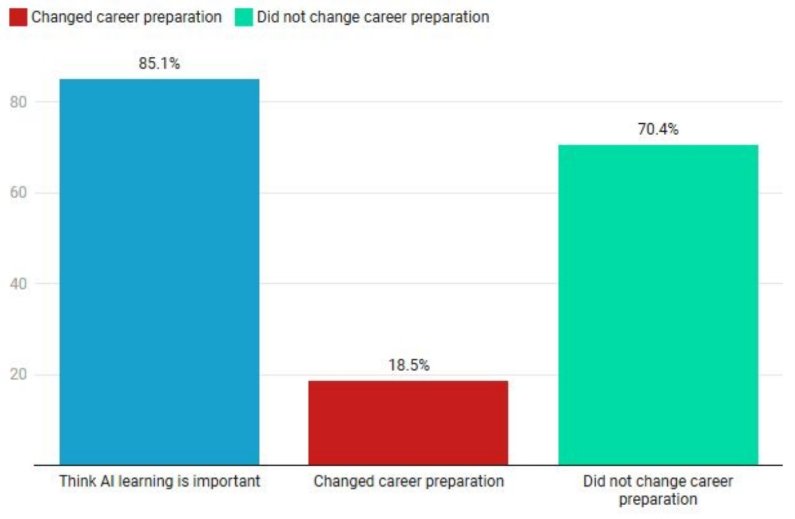
Finding 3: Students recognize AI is important, but they haven’t taken action on actual job preparation
Finding 3: Students recognize AI is important, but they haven’t taken action on actual job preparation
Finding 3: Students recognize AI is important, but they haven’t taken action on actual job preparation
Survey evidence: 85.1% think AI learning is important for future career preparation, but only 18.5% said AI changed their career preparation.
Survey evidence: 85.1% think AI learning is important for future career preparation, but only 18.5% said AI changed their career preparation.
Interview evidence: Participants talked about AI as necessary for staying competitive, but many still planned to stay in their original field because of their personal passion and knowledge.
Interview evidence: Participants talked about AI as necessary for staying competitive, but many still planned to stay in their original field because of their personal passion and knowledge.
Combined insight: AI awareness is high, but its impact is still in the early stages.
Combined insight: AI awareness is high, but its impact is still in the early stages.
Finding 4: Students need support at both skill and career levels
Finding 4: Students need support at both skill and career levels
Finding 4: Students need support at both skill and career levels
Survey evidence: 55.6% want more AI-related courses, 48.1% want faculty guidance, and 44.4% want more internship opportunities.
Survey evidence: 55.6% want more AI-related courses, 48.1% want faculty guidance, and 44.4% want more internship opportunities.
Interview evidence: Participants mentioned uncertainty about junior roles and might need more support from school.
Interview evidence: Participants mentioned uncertainty about junior roles and might need more support from school.
Combined insight: Students already understand that AI is becoming important, but many are still unsure how to respond to that change in a concrete way. For some students, AI may not feel strong enough to change their career path yet; for others, they may know AI matters but do not know which tools, skills, or career steps to focus on. This suggests that the main issue is not only AI awareness, but how to translate that awareness into clearer career preparation.
Combined insight: Students already understand that AI is becoming important, but many are still unsure how to respond to that change in a concrete way. For some students, AI may not feel strong enough to change their career path yet; for others, they may know AI matters but do not know which tools, skills, or career steps to focus on. This suggests that the main issue is not only AI awareness, but how to translate that awareness into clearer career preparation.

Takeaways / Actions
Takeaways / Actions
Takeaways / Actions
01
01
Teach AI as workflow, not only as tools
Teach AI as workflow, not only as tools
Teach AI as workflow, not only as tools
Students need to understand how AI fits into design, engineering, research, and production workflows.
Students need to understand how AI fits into design, engineering, research, and production workflows.
02
02
Help students translate AI use into career preparation
Help students translate AI use into career preparation
Help students translate AI use into career preparation
Many students use AI but fewer know how to connect it to portfolios, role choices, or junior job readiness.
Many students use AI but fewer know how to connect it to portfolios, role choices, or junior job readiness.
03
03
Keep human expertise central
Keep human expertise central
Keep human expertise central
AI can help students cross task boundaries, but judgment, user research, design thinking, and technical review still matter.
AI can help students cross task boundaries, but judgment, user research, design thinking, and technical review still matter.
LOOKING FORWARD: AI AS A NEW CAREER SHIFT
LOOKING FORWARD: AI AS A NEW CAREER SHIFT
“AI may be like the internet era. It will change many jobs and may even remove some of them, but it will also create new roles that require new skills. We are still at the early stage of this wave, so students should pay attention to where these changes are going.”
“AI may be like the internet era. It will change many jobs and may even remove some of them, but it will also create new roles that require new skills. We are still at the early stage of this wave, so students should pay attention to where these changes are going.”
— Interview Participant 03
— Interview Participant 03