


Eco Explore
Eco Explore
Eco Explore
Nature, Reimagined for Future Generations
Nature, Reimagined for Future Generations
A next-generation VR learning experience powered by AI and real-time interaction. This project explores how generative AI can reshape design workflows, rapid worldbuilding, and spatial storytelling.
A next-generation VR learning experience powered by AI and real-time interaction. This project explores how generative AI can reshape design workflows, rapid worldbuilding, and spatial storytelling.
TIMELINE & STATUS
TIMELINE & STATUS
4 weeks
4 weeks
Team of 2
Team of 2
TOOLS
TOOLS
Figma + AI Production
Figma + AI Production
ChatGPT Image 2, Seedance 2.0, Nanobanana Pro, Kling 3.0, ChatGPT, Gemini
ChatGPT Image 2, Seedance 2.0, Nanobanana Pro, Kling 3.0, ChatGPT, Gemini
SKILLS
SKILLS
End-to-end Product Design
End-to-end Product Design
User Research, Competitor Analysis, Interaction Design, Visual Design
User Research, Competitor Analysis, Interaction Design, Visual Design
Why Eco Explore?
Why Eco Explore?
Most educational tools present animals as isolated facts or immersive experiences, but fail to show how ecosystems function as dynamic, interconnected systems.
Most educational tools present animals as isolated facts or immersive experiences, but fail to show how ecosystems function as dynamic, interconnected systems.
Eco Explore transforms environmental learning into an interactive spatial experience, allowing users to observe how animals, climate, terrain, and human activity influence one another in real time through immersive VR exploration.
By combining AI-assisted worldbuilding, real-time interaction, and ecosystem simulation, the platform creates a more engaging and intuitive way to understand biodiversity, ecological balance, and environmental impact beyond traditional classroom learning.
Eco Explore transforms environmental learning into an interactive spatial experience, allowing users to observe how animals, climate, terrain, and human activity influence one another in real time through immersive VR exploration.
By combining AI-assisted worldbuilding, real-time interaction, and ecosystem simulation, the platform creates a more engaging and intuitive way to understand biodiversity, ecological balance, and environmental impact beyond traditional classroom learning.
How AI Reshaped Our Design Workflow
How AI Reshaped Our Design Workflow
Prompt → Generate → Select → Refine → Test → Rebuild
Prompt → Generate → Select → Refine → Test → Rebuild
01
01
Research
Research
AI synthesized user needs, learning behaviors, and immersive education scenarios.
AI synthesized user needs, learning behaviors, and immersive education scenarios.
02
02
Competitor Insights
Competitor Insights
AI analyzed VR education products and identified gaps in interaction, content, and immersion.
AI analyzed VR education products and identified gaps in interaction, content, and immersion.
03
03
Wireframing
Wireframing
AI accelerated layout exploration and generated multiple interface and interaction directions.
AI accelerated layout exploration and generated multiple interface and interaction directions.
04
04
UI Generation
UI Generation
AI supported rapid interface iteration across ecosystem selection, learning panels, and spatial controls.
AI supported rapid interface iteration across ecosystem selection, learning panels, and spatial controls.
05
05
Visual Worldbuilding
Visual Worldbuilding
AI generated immersive ecosystem environments, animals, and product-use scenarios.
AI generated immersive ecosystem environments, animals, and product-use scenarios.
06
06
Video Prototype
Video Prototype
AI tools created cinematic motion, scene transitions, and immersive product storytelling sequences.
AI tools created cinematic motion, scene transitions, and immersive product storytelling sequences.
User + Competitor Research
User + Competitor Research
01
01
Human-Led Research
Human-Led Research
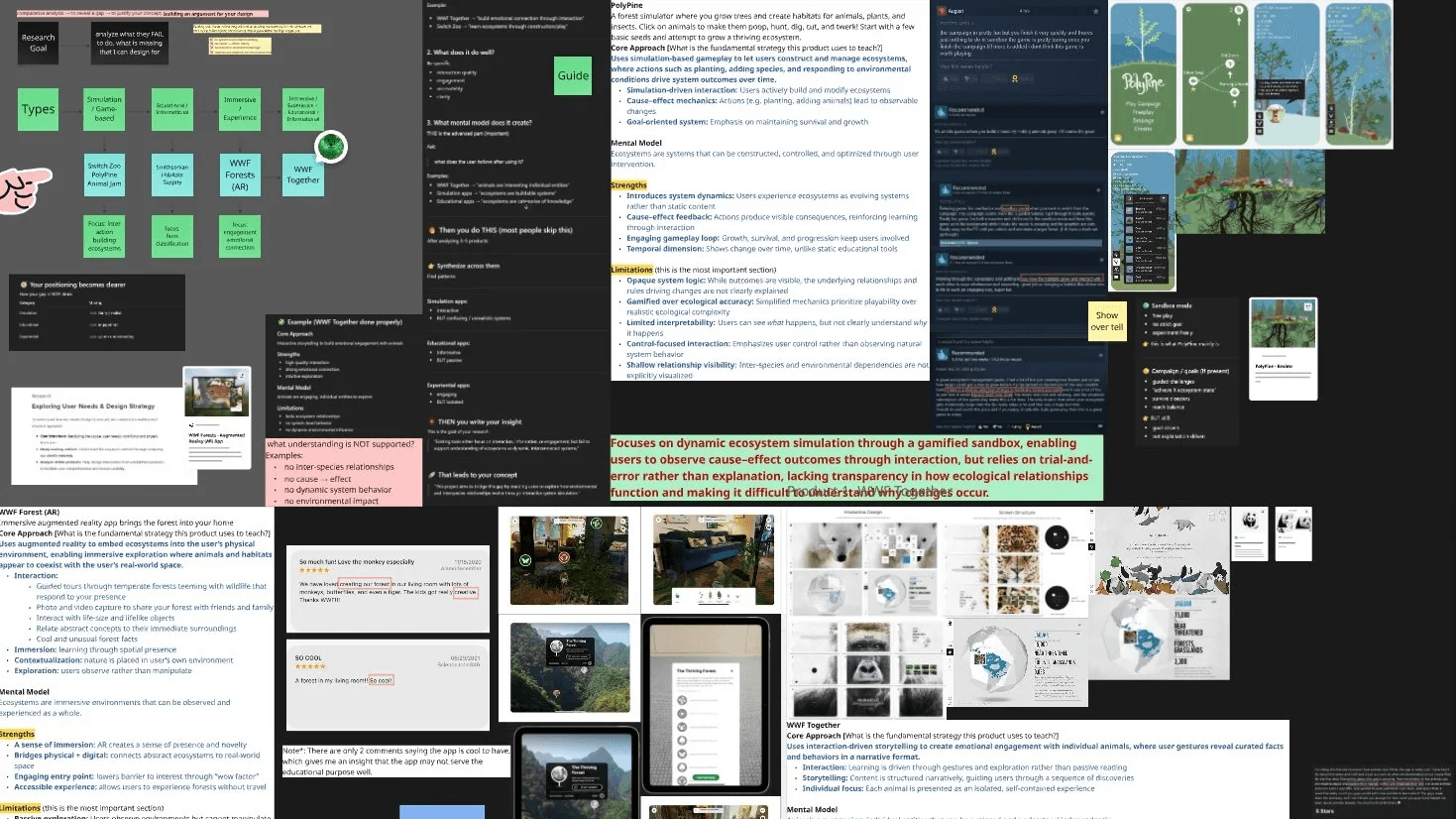
We conducted competitor analysis, market validation, and ecosystem learning research across existing VR and education platforms.
We conducted competitor analysis, market validation, and ecosystem learning research across existing VR and education platforms.

02
02
AI-Accelerated Synthesis
AI-Accelerated Synthesis
AI helped summarize large research datasets, identify recurring patterns, and surface potential product opportunities.
AI helped summarize large research datasets, identify recurring patterns, and surface potential product opportunities.

03
03
Collaborative Decision-Making
Collaborative Decision-Making
Final product directions, interaction systems, and learning experiences were shaped through combined human judgment and AI-assisted exploration.
Final product directions, interaction systems, and learning experiences were shaped through combined human judgment and AI-assisted exploration.
From Research Insights to Product Decisions
From Research Insights to Product Decisions

01
01
Research Insight
Research Insight
Users can explore immersive environments, but they often do not understand the hidden relationships behind ecological changes.
Users can explore immersive environments, but they often do not understand the hidden relationships behind ecological changes.
02
02
Design Goal
Design Goal
Make ecosystem relationships visible, interactive, and easier to understand through cause-and-effect learning.
Make ecosystem relationships visible, interactive, and easier to understand through cause-and-effect learning.


03
03
Product Solution
Product Solution
Eco Explore designs an interactive ecosystem system where users manipulate environmental variables, observe system-level changes, and receive real-time explanations of cause-and-effect relationships.
Eco Explore designs an interactive ecosystem system where users manipulate environmental variables, observe system-level changes, and receive real-time explanations of cause-and-effect relationships.
Core Experience Flow
Core Experience Flow
From ecosystem selection to real-time causal explanation, Eco Explore guides users through an interactive learning loop.
From ecosystem selection to real-time causal explanation, Eco Explore guides users through an interactive learning loop.
01
01
Select Ecosystem
Select Ecosystem
Users choose a biome and preview its system state, species, and key relationships.
Users choose a biome and preview its system state, species, and key relationships.
02
02
Enter Ecosystem
Enter Ecosystem
Users enter a living ecosystem where species, climate, and environmental conditions become visible.
Users enter a living ecosystem where species, climate, and environmental conditions become visible.
03
03
Manipulate Conditions
Manipulate Conditions
Users adjust variables such as temperature, vegetation, rainfall, or predator levels to test system responses.
Users adjust variables such as temperature, vegetation, rainfall, or predator levels to test system responses.
04
04
Observe System Response
Observe System Response
The ecosystem reacts in real time, showing visible changes across animals, plants, and habitat conditions.
The ecosystem reacts in real time, showing visible changes across animals, plants, and habitat conditions.
05
05
Understand Cause & Effect
Understand Cause & Effect
AI explains why the changes occurred, revealing hidden ecological relationships behind the experience.
AI explains why the changes occurred, revealing hidden ecological relationships behind the experience.
Social Impact — Helping Future Generations Reconnect with Nature
Social Impact — Helping Future Generations Reconnect with Nature
Eco Explore uses immersive technology to create meaningful environmental experiences for young learners — fostering curiosity, empathy, and deeper ecological understanding.
Eco Explore uses immersive technology to create meaningful environmental experiences for young learners — fostering curiosity, empathy, and deeper ecological understanding.
Access Beyond Location
Access Beyond Location
Many students may never visit a rainforest, ocean reef, or alpine ecosystem in person. Eco Explore brings these environments into classrooms, homes, and everyday learning spaces.
Many students may never visit a rainforest, ocean reef, or alpine ecosystem in person. Eco Explore brings these environments into classrooms, homes, and everyday learning spaces.
From Watching to Understanding
From Watching to Understanding
Instead of only seeing animals and landscapes, young learners can interact with ecosystem variables and understand how climate, species, and habitats affect one another.
Instead of only seeing animals and landscapes, young learners can interact with ecosystem variables and understand how climate, species, and habitats affect one another.
Building Environmental Empathy
Building Environmental Empathy
By making nature feel close, responsive, and emotionally engaging, Eco Explore helps future generations develop stronger curiosity and care for the natural world.
By making nature feel close, responsive, and emotionally engaging, Eco Explore helps future generations develop stronger curiosity and care for the natural world.
AI Tooling in UI Production
AI Tooling in UI Production

01
01
Prompt to Layout with LLMs
Prompt to Layout with LLMs
AI was used to quickly explore early interface structures, helping us test different ways to organize ecosystem selection, learning panels, and spatial controls.
AI was used to quickly explore early interface structures, helping us test different ways to organize ecosystem selection, learning panels, and spatial controls.

02
02
Human-Led UI/UX Design with Miro
Human-Led UI/UX Design with Miro
AI generated the initial interface directions and layout variations, while the final information architecture, visual hierarchy, and design system were reorganized and refined manually.
AI generated the initial interface directions and layout variations, while the final information architecture, visual hierarchy, and design system were reorganized and refined manually.

03
03
Human-Directed Interface Generation with ChatGPT
Human-Directed Interface Generation with ChatGPT
The core layout structure and visual system were designed manually, then used to guide AI-generated interface iterations across different screens and interaction scenarios.
The core layout structure and visual system were designed manually, then used to guide AI-generated interface iterations across different screens and interaction scenarios.

04
04
Final UI Polish with Figma
Final UI Polish with Figma
After AI-generated interface exploration, final UI polishing and refinement were completed manually using Figma and Figma AI-assisted editing tools. Human designers adjusted spacing, hierarchy, readability, interaction consistency, and visual balance to create a more cohesive and production-ready interface system.
After AI-generated interface exploration, final UI polishing and refinement were completed manually using Figma and Figma AI-assisted editing tools. Human designers adjusted spacing, hierarchy, readability, interaction consistency, and visual balance to create a more cohesive and production-ready interface system.
HUMAN INSIGHT AT THE CENTER
HUMAN INSIGHT AT THE CENTER
AI accelerated every stage of the workflow — but human insight remained at the center of every design decision.
AI accelerated every stage of the workflow — but human insight remained at the center of every design decision.
AI accelerated every stage of the workflow — but human insight remained at the center of every design decision.
Eco Explore Interface Gallery
Eco Explore Interface Gallery


