InHand (Shopify x Base44 x NYC Hackathon)
InHand (Shopify x Base44 x NYC Hackathon)
AI-powered return verification for smarter, safer refunds
AI-powered return verification for smarter, safer refunds
AI-powered return verification for smarter, safer refunds
InHand rethinks the traditional e-commerce return process by introducing AI-assisted, real-time product verification. Customers first describe the issue with their purchase, then complete a series of dynamically generated camera challenges—such as rotating the product, changing angles, adjusting distance, or revealing specific details. AI analyzes these interactions alongside the customer’s claim to determine whether the product condition can be verified.
The goal is to give merchants stronger evidence before approving refunds. By replacing static photo submissions and repetitive manual review with an adaptive verification flow, InHand aims to reduce fraudulent claims, lower operational costs, and create a more trustworthy return experience for both merchants and customers.
InHand rethinks the traditional e-commerce return process by introducing AI-assisted, real-time product verification. Customers first describe the issue with their purchase, then complete a series of dynamically generated camera challenges—such as rotating the product, changing angles, adjusting distance, or revealing specific details. AI analyzes these interactions alongside the customer’s claim to determine whether the product condition can be verified.
The goal is to give merchants stronger evidence before approving refunds. By replacing static photo submissions and repetitive manual review with an adaptive verification flow, InHand aims to reduce fraudulent claims, lower operational costs, and create a more trustworthy return experience for both merchants and customers.
TIMELINE & STATUS
TIMELINE & STATUS
1 day · Team of 4
1 day · Team of 4
TOOLS
TOOLS
Figma, FigJam, Base 44, Codex, Github
Figma, FigJam, Base 44, Codex, Github
ROLE
ROLE
UIUX Designer & Front-end Developer
UIUX Designer & Front-end Developer
SKILLS
SKILLS
Market Research · UX/UI Design · AI Integration · Rapid Prototyping · Front-End Development
Market Research · UX/UI Design · AI Integration · Rapid Prototyping · Front-End Development
THE PROBLEM / MARKET RESEARCH
THE PROBLEM / MARKET RESEARCH
Returns are expensive. Fraud makes them even harder.
Returns are expensive. Fraud makes them even harder.
Returns are expensive. Fraud makes them even harder.
E-commerce returns create significant costs for merchants through the time required to review claims and determine whether they are legitimate.
E-commerce returns create significant costs for merchants through the time required to review claims and determine whether they are legitimate.
$103B+
$103B+
Annual Cost / Loss Related to E-commerce Returns
Annual Cost / Loss Related to E-commerce Returns

Manual verification doesn’t scale.
Manual verification doesn’t scale.
Manual verification doesn’t scale.
Reviewing suspicious claims requires time from customer support or operations teams, making low-value returns especially expensive to investigate.
Reviewing suspicious claims requires time from customer support or operations teams, making low-value returns especially expensive to investigate.
Static evidence is easy to manipulate.
Static evidence is easy to manipulate.
Static evidence is easy to manipulate.
Photos can be reused, edited, selectively framed, or generated, making it increasingly difficult for merchants to determine whether an image accurately represents the returned product.
Photos can be reused, edited, selectively framed, or generated, making it increasingly difficult for merchants to determine whether an image accurately represents the returned product.
What if merchants could verify the product in real time instead of relying on a photo?
What if merchants could verify the product in real time instead of relying on a photo?
What if merchants could verify the product in real time instead of relying on a photo?
THE SOLUTION
THE SOLUTION
From static evidence to live verification.
From static evidence to live verification.
From static evidence to live verification.
We designed InHand as a lightweight plugin that merchants can integrate directly into their existing return experience.
We designed InHand as a lightweight plugin that merchants can integrate directly into their existing return experience.
When a customer requests a return, InHand identifies the product and uses AI to generate a short series of verification challenges based on the item and the reported issue. The customer may be asked to rotate the product, change the viewing angle, move closer to a damaged area, or reveal specific details while keeping the camera live.
When a customer requests a return, InHand identifies the product and uses AI to generate a short series of verification challenges based on the item and the reported issue. The customer may be asked to rotate the product, change the viewing angle, move closer to a damaged area, or reveal specific details while keeping the camera live.

01
01
Return Requested
Return Requested
02
02
AI Generates Challenges
AI Generates Challenges
03
03
Live Camera Verification
Live Camera Verification
04
04
AI Review
AI Review
05
05
Decision
Decision
VERIFICATION LOGIC
VERIFICATION LOGIC
Not every return needs human review.
Not every return needs human review.
Not every return needs human review.
Rather than treating every return as suspicious, InHand uses verification to determine how much intervention is actually necessary.
Rather than treating every return as suspicious, InHand uses verification to determine how much intervention is actually necessary.
VERIFIED
VERIFIED
When the product and reported issue are successfully verified, the return can continue through the merchant’s standard refund process without additional review.
NEEDS REVIEW
NEEDS REVIEW
When evidence is incomplete or inconsistent, the case is escalated to the merchant with the relevant verification data for manual review.
HIGH RISK
HIGH RISK
When multiple signals strongly conflict with the return claim, the case is flagged as high risk and the merchant can apply its own return policy before issuing a refund.
DESIGNING THE EXPERIENCE
DESIGNING THE EXPERIENCE
Making verification feel effortless.
Making verification feel effortless.
Making verification feel effortless.
Adding fraud prevention introduces a UX challenge: every additional verification step creates friction for legitimate customers.
Adding fraud prevention introduces a UX challenge: every additional verification step creates friction for legitimate customers.
Our goal was therefore not to maximize the amount of evidence collected, but to collect enough evidence with as little effort as possible.
Our goal was therefore not to maximize the amount of evidence collected, but to collect enough evidence with as little effort as possible.
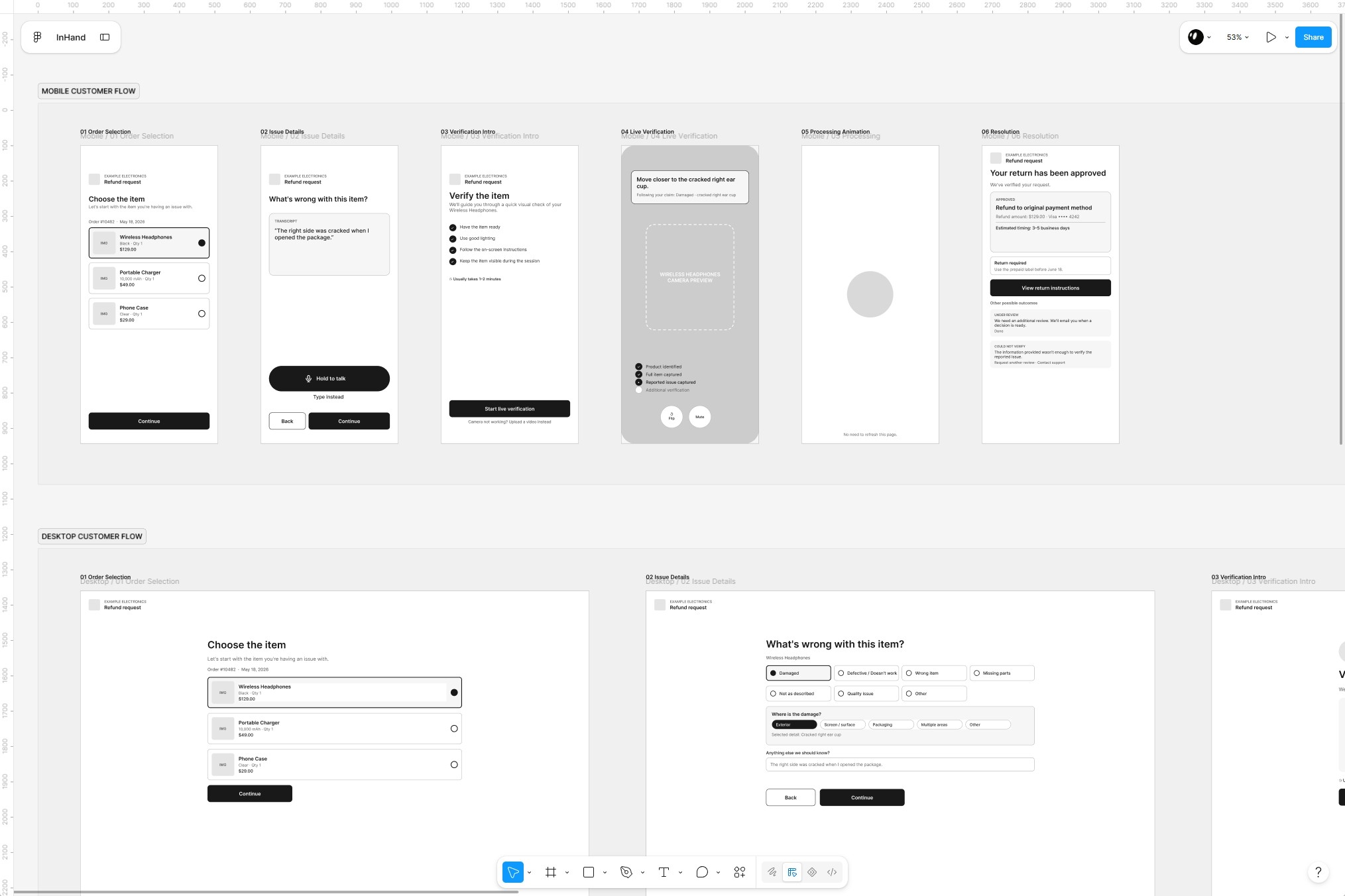
We mapped the experience around a short mobile-first flow: select the return item, describe the issue, prepare the camera, complete a small set of live challenges, and receive a verification result.
We mapped the experience around a short mobile-first flow: select the return item, describe the issue, prepare the camera, complete a small set of live challenges, and receive a verification result.
Early wireframes helped us simplify instructions, reduce unnecessary screens, and make each camera challenge understandable within seconds.
Early wireframes helped us simplify instructions, reduce unnecessary screens, and make each camera challenge understandable within seconds.
01
01
Select Item
Select Item
Select Item
02
02
Describe Issue
Describe Issue
Describe Issue
03
03
Camera Setup
Camera Setup
Camera Setup
04
04
Live Challenges
Live Challenges
Live Challenges
05
05
Verification
Verification
Verification
06
06
Result
Result
Result
RAPID PROTOTYPING
RAPID PROTOTYPING
From design to working prototype.
From design to working prototype.
From design to working prototype.
Once the core interaction was defined, we moved quickly from interface design to a functional prototype using Base44.
Once the core interaction was defined, we moved quickly from interface design to a functional prototype using Base44.
Rather than polishing every edge case first, we focused on testing the central product hypothesis: could a return flow built around AI-generated live camera challenges remain simple enough for customers while providing merchants with stronger evidence?
Rather than polishing every edge case first, we focused on testing the central product hypothesis: could a return flow built around AI-generated live camera challenges remain simple enough for customers while providing merchants with stronger evidence?
Building the prototype allowed us to experience the flow as a connected product rather than a collection of individual screens—and exposed limitations that were much harder to see in static designs.
Building the prototype allowed us to experience the flow as a connected product rather than a collection of individual screens—and exposed limitations that were much harder to see in static designs.

Build Rapid prototype in Base44
Build Rapid prototype in Base44

Export code from Base44 and combine code with the backend
Export code from Base44 and combine code with the backend
Export code from Base44 and combine code with the backend
WHAT WE LEARNED
WHAT WE LEARNED
Product verification is only one piece of the risk puzzle.
Product verification is only one piece of the risk puzzle.
Product verification is only one piece of the risk puzzle.
Our first prototype focused heavily on one question: Does the product in front of the camera match the customer’s claim?
Our first prototype focused heavily on one question: Does the product in front of the camera match the customer’s claim?
Through the process, we realized that this alone is not enough to make a reliable return decision.
Through the process, we realized that this alone is not enough to make a reliable return decision.
A stronger system should evaluate the return in context—combining live product verification with signals such as order information, account history, previous returns, payment consistency, and other merchant-authorized risk data.
A stronger system should evaluate the return in context—combining live product verification with signals such as order information, account history, previous returns, payment consistency, and other merchant-authorized risk data.
AI Product Checker
AI Product Checker
AI Product Checker
→
→
Return Risk Intelligence System
Return Risk Intelligence System
Return Risk Intelligence System
WHERE INHAND COULD GO NEXT
WHERE INHAND COULD GO NEXT
From individual returns to cumulative intelligence.
From individual returns to cumulative intelligence.
From individual returns to cumulative intelligence.
Most return decisions are evaluated as isolated events. A merchant may see the current order and claim, but often lacks a structured way to understand how that return fits into a customer’s broader behavioral history.
Most return decisions are evaluated as isolated events. A merchant may see the current order and claim, but often lacks a structured way to understand how that return fits into a customer’s broader behavioral history.
A future version of InHand could build a merchant-authorized return history from transactions processed through the platform. Instead of starting every verification from zero, the system could combine current evidence with historical return patterns to produce a more contextual risk assessment.
A future version of InHand could build a merchant-authorized return history from transactions processed through the platform. Instead of starting every verification from zero, the system could combine current evidence with historical return patterns to produce a more contextual risk assessment.
The decision system could also adapt to each merchant’s policies and risk tolerance.
The decision system could also adapt to each merchant’s policies and risk tolerance.
A low-value item may qualify for an instant refund, while a high-value or high-risk claim could require stronger verification or manual review.
A low-value item may qualify for an instant refund, while a high-value or high-risk claim could require stronger verification or manual review.
Customer
Customer
↓
↓
Current Return + Live Verification + Order Data + Return History
Current Return + Live Verification + Order Data + Return History
Current Return + Live Verification + Order Data + Return History
↓
↓
InHand Risk Intelligence
InHand Risk Intelligence
InHand Risk Intelligence
↓
↓
LOW RISK
LOW RISK
Instant Refund
MEDIUM RISK
MEDIUM RISK
Additional Verification
HIGH RISK
HIGH RISK
Manual Review