STARTLY
STARTLY
STARTLY
Making the first step feel smaller.
Startly is an AI companion designed for neurodivergent youth who experience task initiation and executive function challenges. Instead of generating another long plan or to-do list, Startly helps users turn something they are avoiding into a small action they can do right now. If the action still feels difficult, the AI can make it smaller again, reducing the friction between intention and action.
TIMELINE & STATUS
1 week · Team of 1
TOOLS
Figma · Codex · Google AI Studio · Gemini API · GitHub
ROLE
Product Designer & Developer
SKILLS
UX Research · Product Design · UI/UX Design · AI Interaction Design · Rapid Prototyping · Front-End Development
THE PROBLEM
Knowing what to do doesn’t always make starting easier.
The idea for Startly began with both personal observation and research. I have experienced procrastination, difficulty staying focused, and moments where I know exactly what needs to be done but still struggle to begin. I did not want to treat my own experience as a substitute for neurodivergent user research, but it gave me a clear starting point for investigating why the first step can create so much resistance.
Many productivity products assume that once tasks are organized, users will be able to act on them. My research suggested that for people experiencing task initiation and executive function challenges, the barrier often happens earlier. Large tasks can feel overwhelming, rewards can feel too distant, and the effort required to organize another productivity system can itself become additional cognitive friction.

RESEARCH & KEY INSIGHTS
Designing with, not just for.
During the project, I researched neurodivergence, ADHD, executive function, task initiation, motivation, and attention, with a specific focus on neurodivergent youth. I spoke with neurodivergent people and people who experience ADHD-related challenges, while also reviewing academic papers, expert advice, community discussions, product reviews, and first-person experiences. AI helped me collect and organize large amounts of information more efficiently, but the purpose of the research was to identify recurring human problems rather than let AI define the solution.
Several patterns appeared repeatedly. Knowing what needs to be done does not necessarily reduce the friction of beginning. Large tasks can create disproportionate emotional resistance, traditional productivity systems often delay rewards until completion, and tools built around dashboards, calendars, streaks, and constant organization can become another task users have to maintain.
Starting can be harder than planning
Large tasks create resistance
Rewards often arrive too late
Productivity systems can become work themselves
REFRAMING THE PRODUCT
We didn’t need another productivity planner.
The research changed the direction of the product. I initially explored several familiar productivity patterns, but many of them recreated the same problem I wanted to solve. A complex planner, task tracker, calendar, productivity dashboard, daily check-in system, or streak mechanic would introduce additional decisions and maintenance for users who may already be experiencing cognitive overload.
Startly therefore adopted a deliberate “less is more” approach. The interface contains very little navigation or structure that users need to learn, and most of the experience happens naturally through conversation with the AI. Instead of helping users organize everything they need to accomplish, Startly focuses on one specific moment: reducing the distance between wanting to do something and actually beginning it.

DESIGNING THE CORE EXPERIENCE
Make the first action easier than the task itself.
One of the strongest influences on Startly was James Clear’s Atomic Habits, particularly the idea that a behavior becomes easier to begin when the first step is extremely small. Instead of asking someone to think about completing a two-hour assignment, Startly focuses on identifying an action that can be started immediately and requires very little commitment.
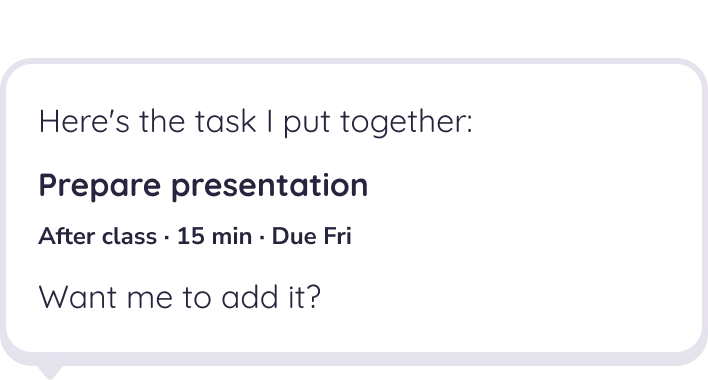
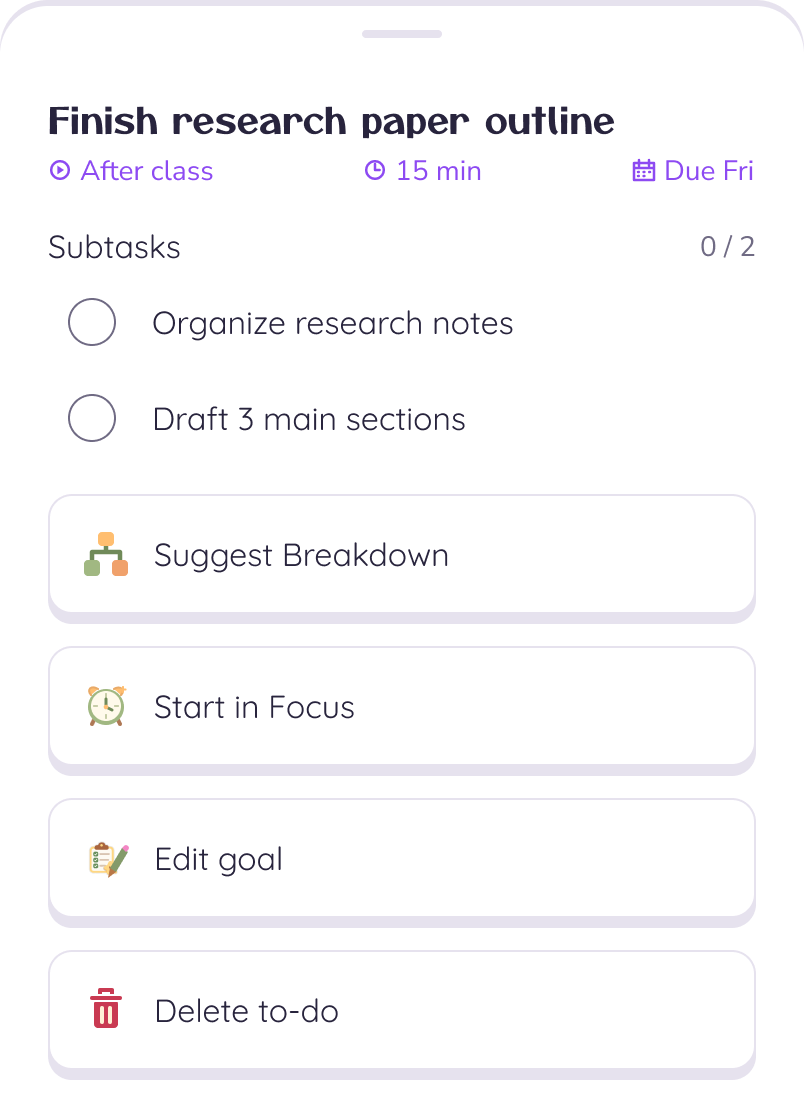
Users can simply tell Startly what they are avoiding or struggling to begin. The AI interprets the situation and suggests one small action. If that action still feels difficult, the user can ask Startly to make it even smaller. The purpose is not to generate a complete plan at the beginning, but to lower the activation energy required to take the first real step.
THE DEFAULT RESPONSE
“I need to work on my presentation.” → Research the topic → Create an outline → Design slides → Practice presentation
STARTLY BEGINS WITH
“Open the presentation file.”
Making continuing easier than restarting.
Reducing the first step was only part of the interaction. I also wanted to reduce friction between actions, so I borrowed from Netflix’s “Play Next Episode” pattern. Once a user completes one small action, Startly can automatically suggest and transition into the next step unless the user pauses or stops. This reduces repeated decision-making and helps preserve the momentum created by successfully beginning.

THE JAR REWARD SYSTEM
Making invisible progress visible.
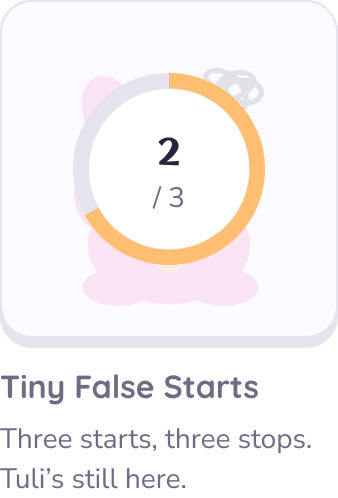
The Jar was inspired by James Clear’s Paper Clip Strategy, where completing an action is represented by physically moving a paper clip from one container to another. The reward is intentionally small, but it makes progress visible immediately. I adapted that idea into a digital system where every real action completed through Startly adds a new piece to the user’s Jar.
The Jar is deliberately different from a traditional productivity dashboard. It does not measure whether someone is productive enough, show how much work remains, or remove progress when a user stops using the product. I also chose not to build streaks because missing several days or breaking a streak can turn a reward mechanism into another source of pressure or guilt. The Jar only preserves evidence of actions the user has already taken.

FROM DESIGN TO WORKING PROTOTYPE
AI accelerated the process, but it didn’t replace the design process.
I used AI throughout the project to reduce repetitive work and move from research to a working prototype more quickly. After synthesizing the research, I used ChatGPT together with Figma to organize findings, explore wireframes, structure the UX, develop the visual direction, and refine the interface. Once the experience was sufficiently defined, I used the Figma designs as references for Google AI Studio and turned the concept into a functional prototype that testers could actually use.
The implementation process also exposed the limitations of AI-assisted development. Early AI-generated versions frequently misunderstood the Jar, changed interaction logic, introduced unnecessary UI, or transformed simple interactions into overly complicated screens. Sending more prompts did not automatically improve the result. I eventually reorganized the workflow and treated research, synthesis, wireframes, UI, implementation, and testing as separate stages that each required human review.
AI can compress execution time, but it cannot replace design judgment.
Research →
Research →
Synthesis →
Synthesis →
Design →
Design →
Prototype →
Prototype →
Testing →
Testing →
Iteration
Iteration

Academic+Expert+Competitor+User Research

Wireframe

Moodboard

Final UI Polish
TESTING & ITERATION
Real use exposed problems static screens could not.
Testing became an important part of the process once the prototype was interactive. Instead of designing the complete experience alone and validating it only at the end, I began showing working versions to users and collecting feedback earlier. This revealed problems that were difficult to notice in Figma, particularly around information density, input behavior, accessibility of voice interaction, and how clearly the product communicated progress.
Feedback led to several changes. Voice and text input needed to feel more connected rather than separated, the voice action needed to remain easy to access, unnecessary information had to be removed from moments where it distracted from the current task, and the reward loop needed stronger visual feedback. The cumulative progress represented by the Jar also needed to remain more visible so users could immediately understand what they had already accomplished.
Voice and text felt disconnected
→ Integrated them more closely into the same interaction.
Voice interaction was too easy to lose
→ Made the voice action more persistent and accessible.
Some screens contained unnecessary information
→ Reduced information density and focused each state on the immediate action.
Progress feedback was not visible enough
→ Strengthened the Jar and cumulative progress feedback.

REFLECTION & FUTURE DIRECTION
More functionality does not automatically create a better product.
The most important lesson from Startly was about restraint. When designing around task initiation, executive function, attention, and emotional friction, every additional decision has a cost. Another page, button, notification, metric, productivity mechanic, or check-in may add functionality while simultaneously making the product harder to begin using. In this context, deciding what the product should not ask the user to do became just as important as deciding what features to build.
The project also changed how I think about AI-assisted design and development. AI helped me research faster, organize information, prototype interactions, and reduce repetitive implementation work, but whenever I tried to skip a stage and allow AI to determine the product direction independently, the result became less accurate. The workflow became faster, but the need for research, testing, and design judgment remained.
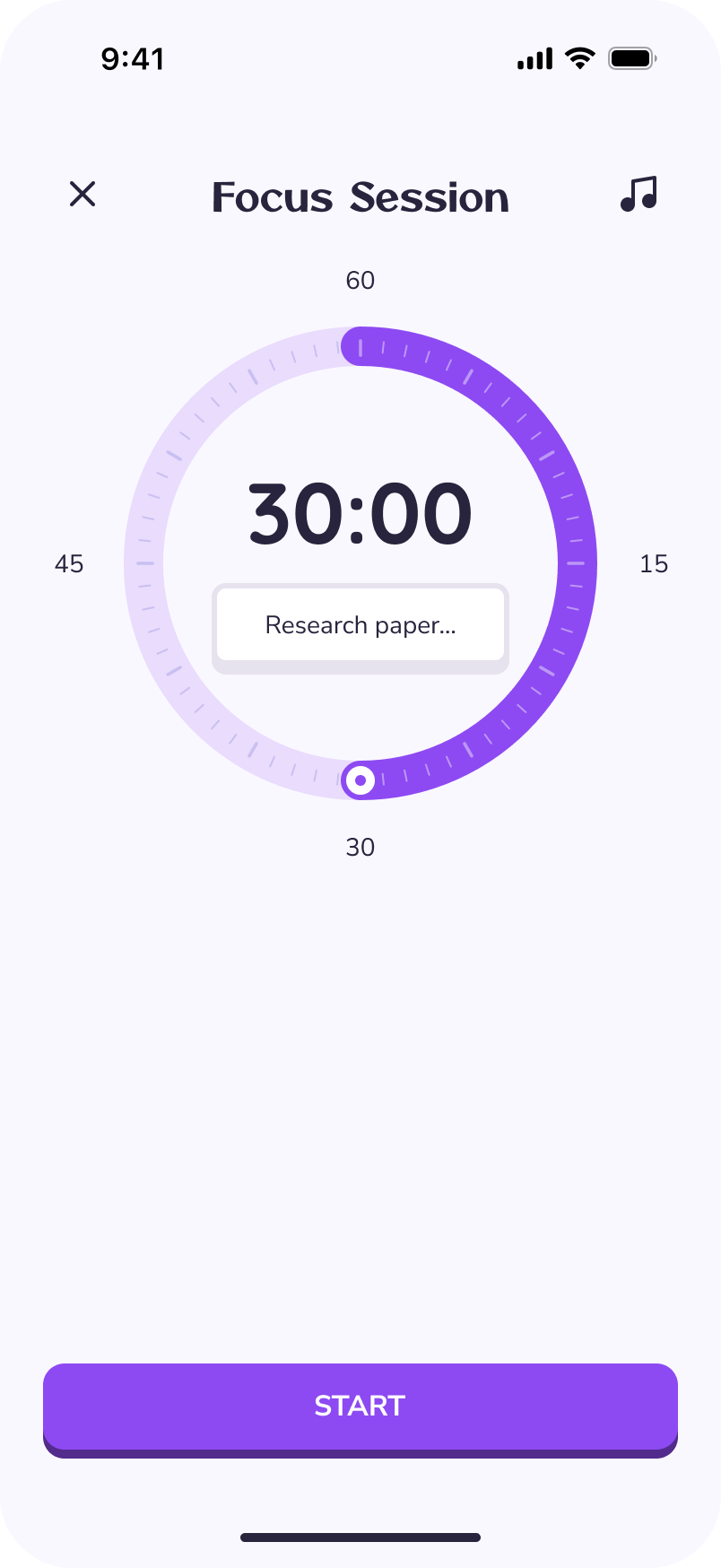
Future Direction: Building a deeper focus environment.
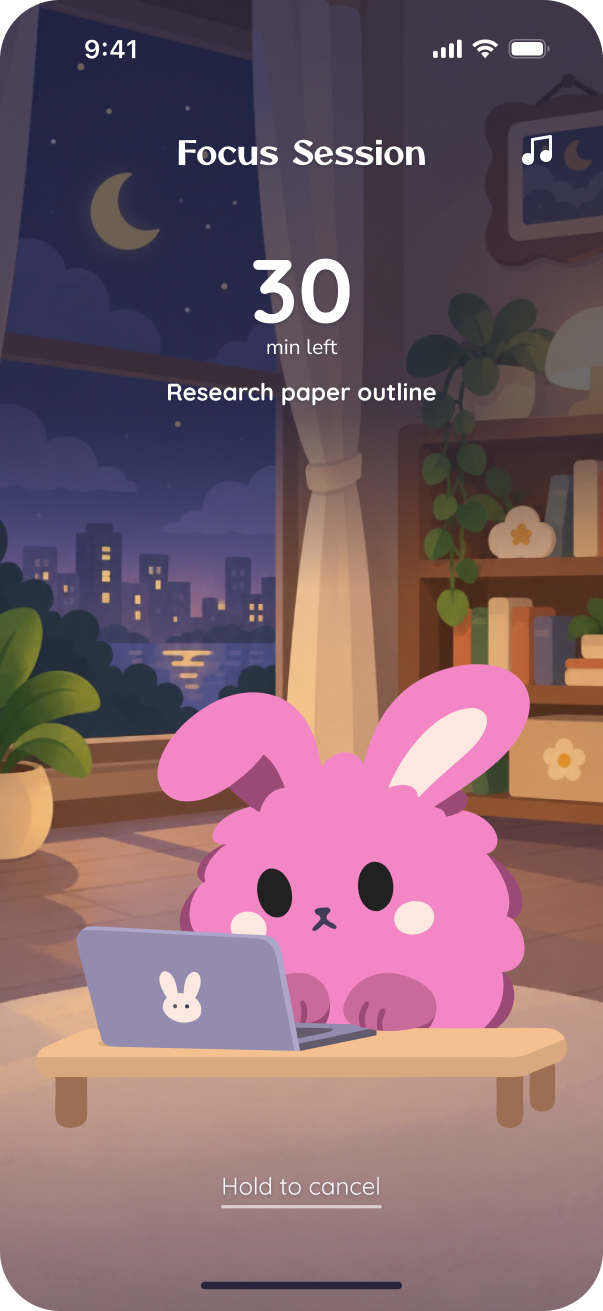
If Startly became a real product, the next iteration would focus on refining the complete transition between conversation, starting a task, entering a working state, maintaining focus, and receiving a reward. A native mobile version could connect with device-level focus and notification controls so that entering Working Mode could reduce interruptions from other apps. I would also continue refining motion, visual guidance, transitions, and the Jar system through testing with neurodivergent youth rather than simply expanding the feature set.
Make starting easier. Make progress visible. Make the next action feel possible.